
+7 (499) 647-49-78
+7 (499) 647-49-78
We have prepared an extended IPTV/OTT service scheme with Microimpuls products, using which you can build the right infrastructure, allowing further scaling and development of the service.
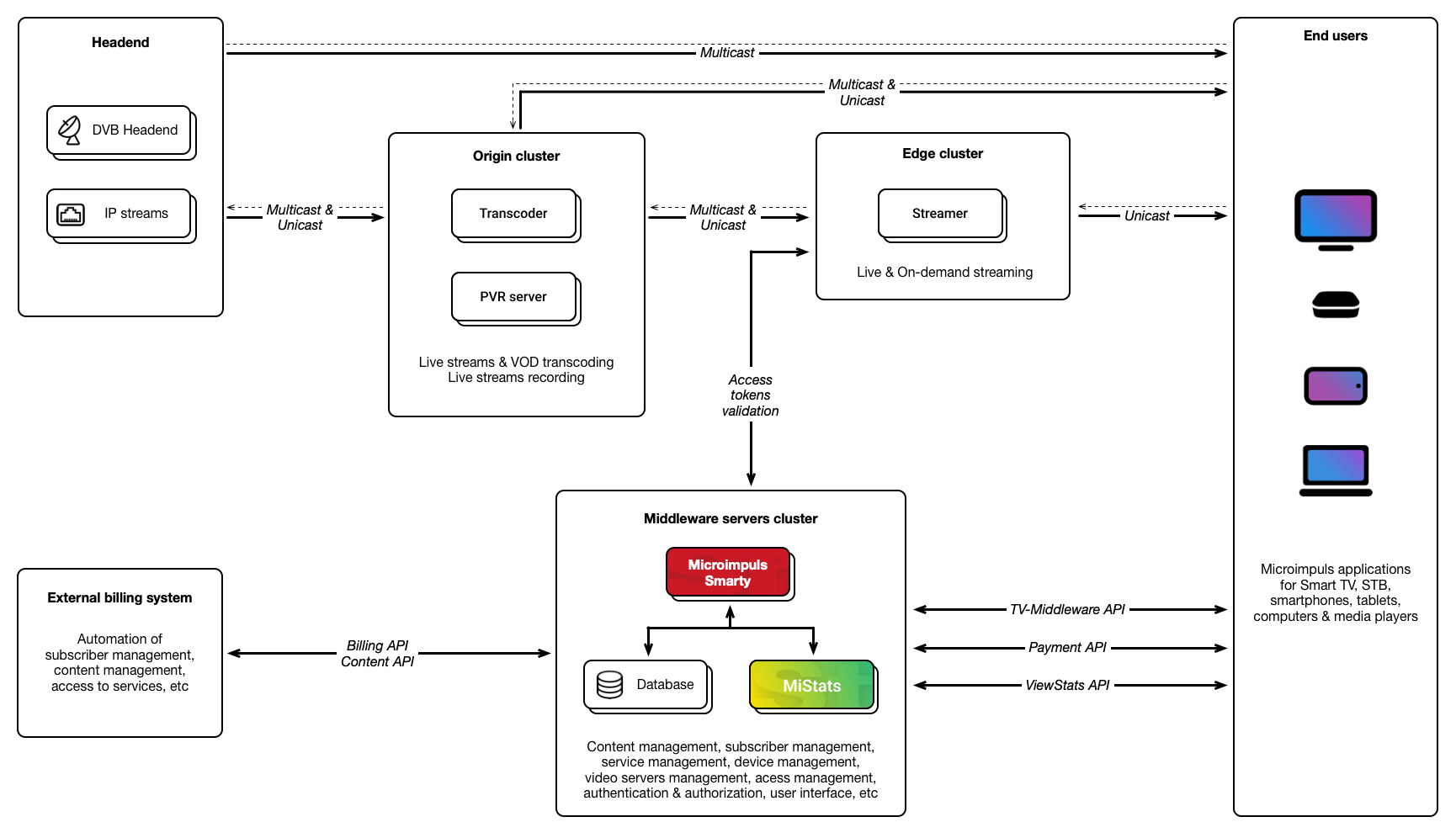
On the right side of the circuit is a block End users — these are your subscribers who can use various devices to view the service, such as Linux and Android carriers, Smart TVs, smartphones and tablets, as well as other devices that can view video content.
The Microimpuls platform is compatible with most of these devices, and we are constantly working to add support for new kinds of devices and models.
On the left side of the circuit is a block Headend — this is the operator's head station or the place where video signals of TV channels are formed. The signal can be received in various ways — from satellite (DVB-S/S2), from broadcast (DVB-T/T2), via IP (terrestrial delivery methods) through a direct connection to the source or via the Internet.
As a result, video streams of TV channels in various formats are formed at the operator’s head station, which should then be brought to the end subscribers. The best way is to transcode all signals into HLS — the most widely used standard for streaming video to IP. This will provide maximum support for devices and stable video playback on any screen.
Between the head station of the operator and subscribers on the scheme is the most time-consuming — components for transcoding and bringing content to subscriber devices.
In the Origin-Edge scheme, content preparation servers act as Origin, and as Edge — video stream distribution servers to end subscribers. This allows you to reduce the number of Origin servers to the minimum number required for video production, improve their security and reliability, and reduce the network bandwidth requirements between Origin and Edge servers. At the same time, only Edge servers remain dependent on the number of subscribers and their total load.
Original cluster — is a group of video servers designed for video transcoding (change the format of the stream, video and audio codecs and their parameters), as well as video recording for a delayed viewing service (Timeshift, Catch-Up, Pause Live TV).
For transcoding, the solution will help Microimpuls Spectr. This software allows you to recode the video into the desired format, and then form an output stream from it and distribute it to users via IP, or transfer it to a further video processing site.
A solution can be used to record video MicroPVR. This software is designed to record video in files for the required number of days, with automatic rotation of the archive, which will provide subscribers with non-linear viewing services.
For transcoding and recording video, you can also use third-party solutions, for example, products from Flussonic or Elecard — the architecture of the platform is not rigidly tied only to internal video products.
At the initial stage, the operator may refuse to recoding video, but this will not allow to provide subscribers with high-quality service on Smart TV and mobile devices, as well as provide service over the Internet, not limited to its local network.
Depending on the number of channels and the number of recorded channels, a different number of transcoding and writing servers are required. All Microimpuls video products allow you to build clusters in such a way as to ensure fault tolerance and redundancy of the service.
Edge cluster — is a group of video servers designed to stream video to end users. For this purpose, it will also help Microimpuls Spectr.
Multiple Spectr servers can be combined into a cluster to create a fault-tolerant and geographically distributed network that allows you to withstand a significant load from a large number of simultaneously browsing users.
Start-up companies with a small number of users can be limited to a simplified scheme, since Spectr, used as Origin, can also stream video to end devices.
IPTV operators that broadcast only Multicast on their network and do not yet need support for Smart TVs and mobile devices can do without video processing servers, broadcasting Multicast directly from the head station. If you need to implement delayed browsing and pause services, you can also use MicroPVR software, since it allows you to write the original streams without transcoding.
The core of the IPTV/OTT service is the server Middleware. This is the main product of our company — Microimpuls Smarty.
Smarty — is an interactive TV and online cinema management system. Smarty provides interaction of user devices and applications with the service, authenticates and authorizes user accounts, manages content, video servers, charging, devices, subscriptions, and also keeps records of TV viewing and performs many other tasks.
Applications interact with the Smarty server by TV-Middleware APIand Payment API (to make payment from the screen) and ViewStats API (tv viewing records).
Large companies can use several Smarty servers in cluster mode to build a fault-tolerant service that allows you to serve a very large number of users online.
For small operators there is a lightweight version Smarty Lite, this will allow you to start on a small budget and then seamlessly upgrade to the main version of the platform.
As a rule, for the implementation of their commercial activities, operators use automated settlement systems (ACP) — otherwise billing systems. On the block chart External billing system connections Billing API and Content API the possibility of integrating the billing system of the operator and the Smarty management server is shown, which allows automating the processes of managing subscribers and their subscriptions, as well as content management.
Thanks to this opportunity, the employees of the relevant services of the operator can work in their usual environment — billing, and all operations will be automatically duplicated in Smarty. There is also a feedback —. Smarty will request the necessary information to work directly in the billing system.

Software for transcoding and Unicast-streaming video.

Software for non-linear TV services - Catch-Up, Timeshift, Pause Live TV.

Interactive IPTV/OTT service management system.

Service for storage and analysis of television viewing.
We strive to create and develop each product in such a way that it integrates as well as possible with our other products, but not only with them — using an open architecture, having an API, and working with partners allows you to use Microimpuls products in combination with products from other companies. For example, you can use a Smarty Middleware management system, but use other companies’ solutions for transcoding and streaming, or vice versa.
Send a request
